
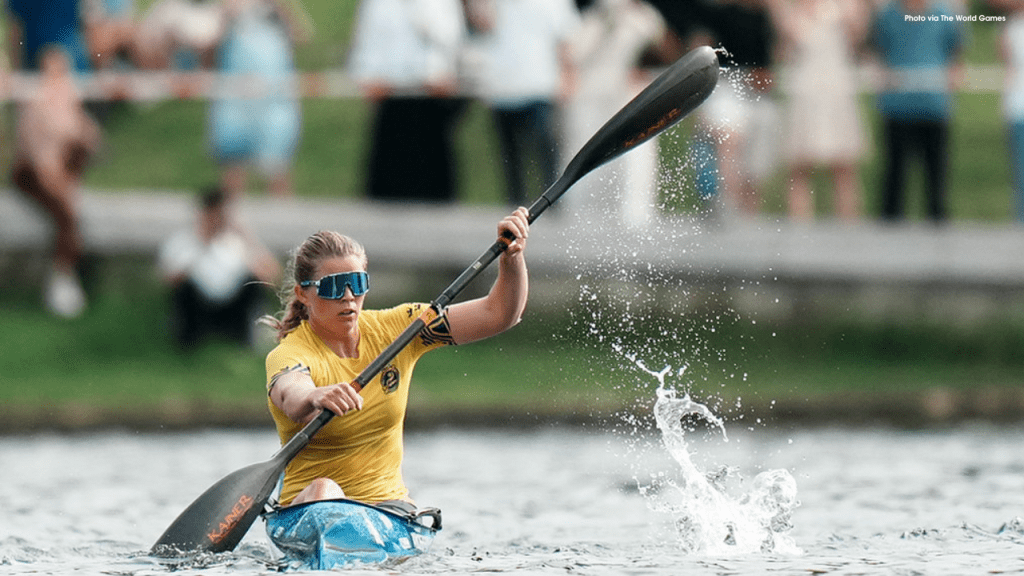
The World Games in Chengdu, China last weekend delivered intense battles for not just the top spots, but right down the field too, with close sprints for bronze and below. Reigning World Champions Melina Andersson and Mads Brandt Pedersen dominated their respective races, despite the prowess of their greatest rivals, Vanda Kiszli and Hamish Lovemore.
The Olympics of non-Olympic sports, the World Games featured 20 athletes from 20 countries in each race, with a level of competition nearing that of the Olympics. Opposite conditions from Saturday to Sunday challenged the racers — in the 3.4km short course race on Saturday, Xinglong Lake was beautifully flat, but temperatures exceeding 37 degrees Celsius were hot enough to put one racer into the medical tent. On Sunday, the wind arrived and any relief at cooler temperatures was dampened by huge waves and chop smashing into the paddlers from the side and making smooth portaging tricky for even the best racers.
Speaking to Paddlecast, Melina Andersson said she’s used to training in similarly choppy conditions, but these were tough, and even worse than they looked on the live stream. She ended up having to adapt her tactics in real time to avoid any missteps on the portages. Melina said, “It was really hard just keeping the balance, because you were paddling in a side wind for a long time… I knew that the portage was going to be a bit shaky, so I was taking it really slow on the take outs, and then running hard instead and be fast into the boat [on the put-ins] because I felt like it was a bit less wind where you put the boat in.”
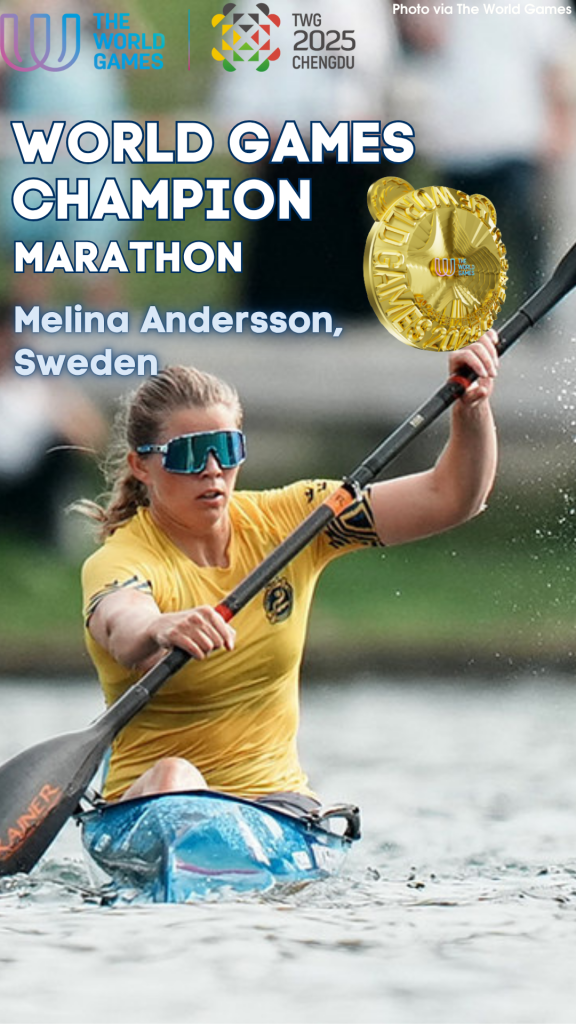
Melina Andersson, marathon queen
In the women’s races, Melina Andersson looked strong out of the gate in both the short course and marathon events. But Vanda Kiszli was determined to challenge for the win, and stuck with Melina successfully until Melina’s superior portaging skills gave her an unbeatable lead. Kiszli has so many World and European championship titles from the last 10 years or so that it’s hard to keep track. So to see Andersson out-portaging and out-paddling Kiszli on every lap was quite a sight.
When asked how early she knew she was going to take the win, Andersson said you never really know because things can go wrong in marathon racing, but she knew she was feeling strong as early as the first portage. As she neared the last couple of laps having traded leads with Kiszli for much of the race, Melina picked up the pace off the final portage and finished with a commanding lead, winning by almost 2 minutes. The multiple world champion from Hungary, Vanda Kiszli, may not have been able to challenge Melina in the last couple of laps but she was equally untouchable for the rest of the racers. Kiszli was a minute and a half ahead of 3rd place. But what a battle for bronze it was.
The battle for bronze
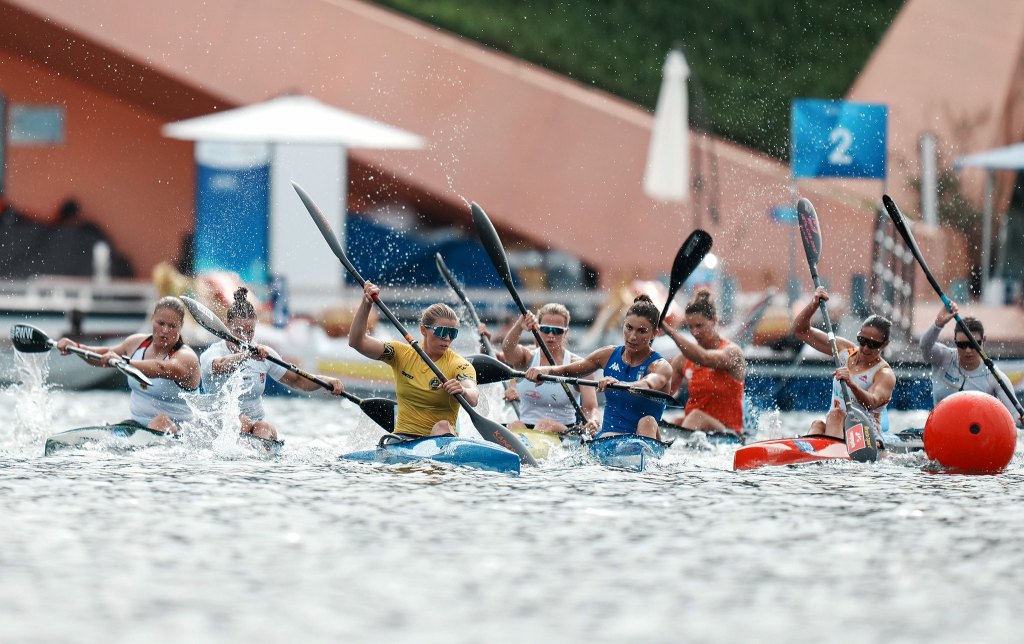
The action was hot in the chase group with Pernille Hostrup, Susanna Cicali, Maria Rei, Saskia Hockly, Eva Barrios, Rebecca Mann, and others. Several young athletes put down really impressive performances in the face of challenges: Hostrup got knocked off the front pack early in the race when the leaders picked up the pace after she tried to move into a better position; and Hockly spent several laps leading the chase pack and looking like a strong bet for bronze until she had a misstep on one of the later portages and lost time dumping water from her boat. But Hostrup managed to recover successfully from her early drop, worked her way back up the field into a head-to-head battle against Maria Rei of Portugal for bronze. The Dane pulled it off with an impressive sprint finish that she almost made look easy.
Is Kitty Schiphorst a triple threat?
At least one paddler in the chase was enjoying Sunday’s brutal conditions: Kitty Schiphorst from the Netherlands, for whom the World Games was her first international marathon race. The Dutch paddler is mostly known for her success in sprint, where she finished top 5 in the 1000m race at European championships this year and at the Poznan World Cup last year. She’s also a top racer in Surf Lifesaving (SLS), which is what gave her an edge on Sunday. “There was wind, there was rain, there was waves… I saw the other girls struggling, and I absolutely loved it. I was really really happy to end up in the Top 10… I crossed the finish line and I was just smiling, and turned to my coach and said ‘oh my god I loved it so much, it was so fun.’” Kitty credits her surfski experience with why she was able to remain calm and stable in big waves, and use that to her advantage while some of the paddlers from more flatwater backgrounds struggled.
Kitty hasn’t decided yet if she’ll race at the Marathon World Championships in Gyor, Hungary later this year, but if she does decide to do more marathon racing, she could be a very serious threat in not one, not two, but three paddling disciplines.
The men’s race
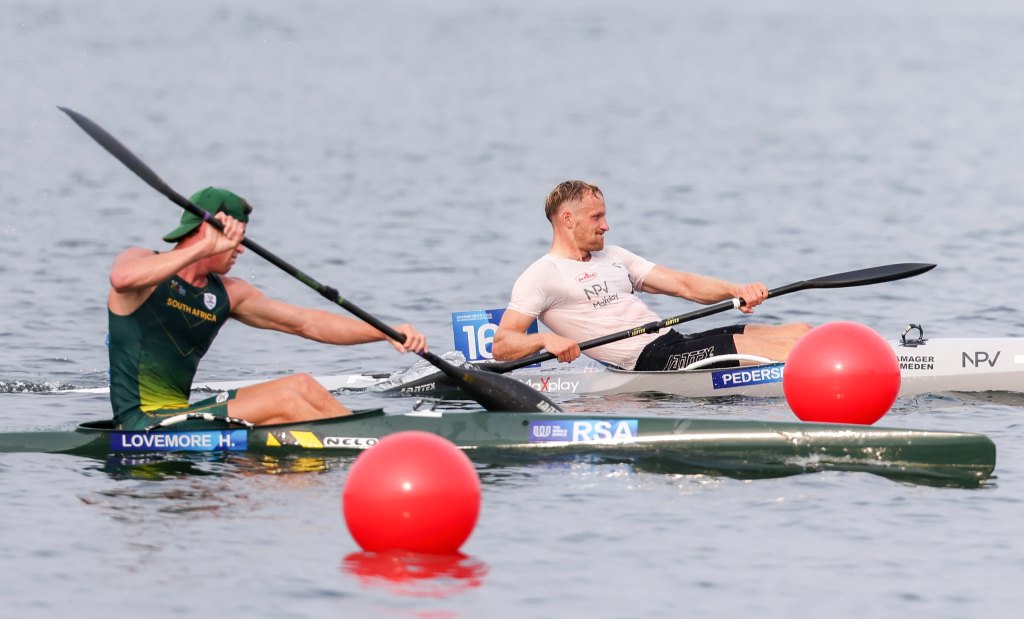
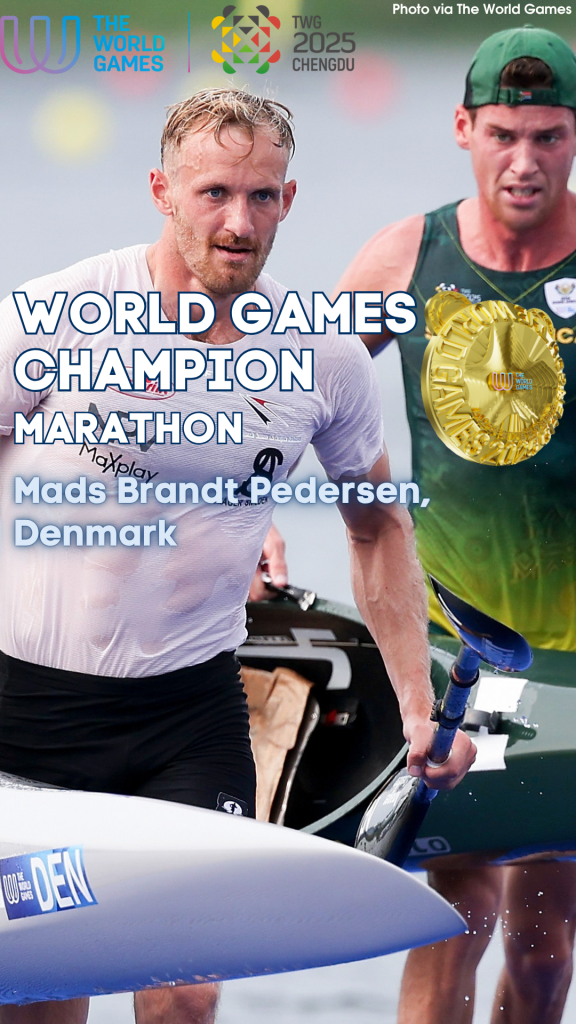
In the men’s race, sprinter Hamish Lovemore went into the short course on Saturday aiming to beat Mads Brandt Pedersen in a sprint finish. The South African Olympian has had some of his best results ever in the past year, including a silver medal behind Hungarian Balint Kopasz at the Szeged World Cup in May. With his main focus being on sprinting, he was banking on his speed to be his advantage against reigning (and multiple) World Champ Mads Brandt Pedersen. Hamish said of the race on Paddlecast, “When it broke down to just Mads and I, my strategy was working out perfectly where I could almost just sit on the wave and try to save everything for a big sprint. I think we averaged just over 15.3 [km/hr], so to just sit on the wave is actually not so easy…” Just as Hamish fired off his sprint to the finish, Mads picked up his speed even higher. The marathoner held off the sprinter to take gold.
On Sunday, Hamish stuck to Mads like glue again, determined to challenge for the win. Mads is known for wanting to lead from the front, often happy to go it alone, and using his speed on portages to drop racers trying to stay with him. Knowing the risk of getting dropped by Mads on a portage, Hamish showed exceptional tactical savvy in working hard to get ahead of Mads on each portage and even positioning himself in front of the Dane to force him to stay close. Mads seemed happy enough to oblige, as long as Hamish took the lead coming out of the portage.
As the two fierce rivals neared the finish, Mads made his move early and hard as he tried, Hamish just missed out on gold again, this time by the slightly larger margin of ten seconds.
On Paddlecast, Hamish spoke in more depth about his race as well as his upcoming plans for the Sprint World Championships in Milan, where he may have his best results yet, and his plans to race against a larger field at the Marathon World Championships in Gyor where the addition of his countryman Andy Birkett will provide even tighter competition.
The chase pack
The men’s chase pack featured plenty of major names in the sport including Jose Ramalho, Jeremy Candy, James Russell, Jon Amund Vold, Ivan Alonso, and more… But it was the Hungarian Noe Balint and German Nico Paufler who managed to stay with the two leaders for much of the race in a pack of four, until they too were burnt out by Mads’ and Hamish’s speedy pace. The men gave it their all in exciting sprint finishes for 3rd and 5th place, where Jose Ramalho (Portugal) edged out Jeremy Candy (France) for bronze, and Noe Balint managed to just barely hold off James Russell (Great Britain) for 5th.
Listen to the World Games Recap episode of Paddlecast to hear the full analysis from co-hosts Billy and Betsy, and hear from Melina Andersson, Hamish Lovemore, and Kitty Schiphorst in their own words — those full interviews are well worth a listen. The episode is available on YouTube (below), Spotify, Apple Podcasts, or wherever you get your podcasts.
 Paddle Daily
Leave a comment