
The inaugural Thames 200 Ultra was an ambitious undertaking: it was only announced three months ago (not very long to train for an ultra, let alone plan and run one), open to all sorts of crafts and experience levels (SUP, kayak, canoe, prone; amateur, elite), run by a first-time race director (who happens to hold the Devizes to Westminster race record in a double kayak), promoted by BBC nature presenter Steve Backshall, designed to help racers set new Guinness World Records… Could they really pull it off?
On the 24-25th of August, nearly 100 competitors and thousands more fans online and in-person found the answer. Not only did the Thames 200 Ultra achieve its aspirational aims, but the race attracted top paddlers from SUP, kayak, and canoe disciplines. As they reached the giant pink “RACE FINISH” banners 200 km from where they started, almost every single paddler said the same thing: they’ll be back again next year.
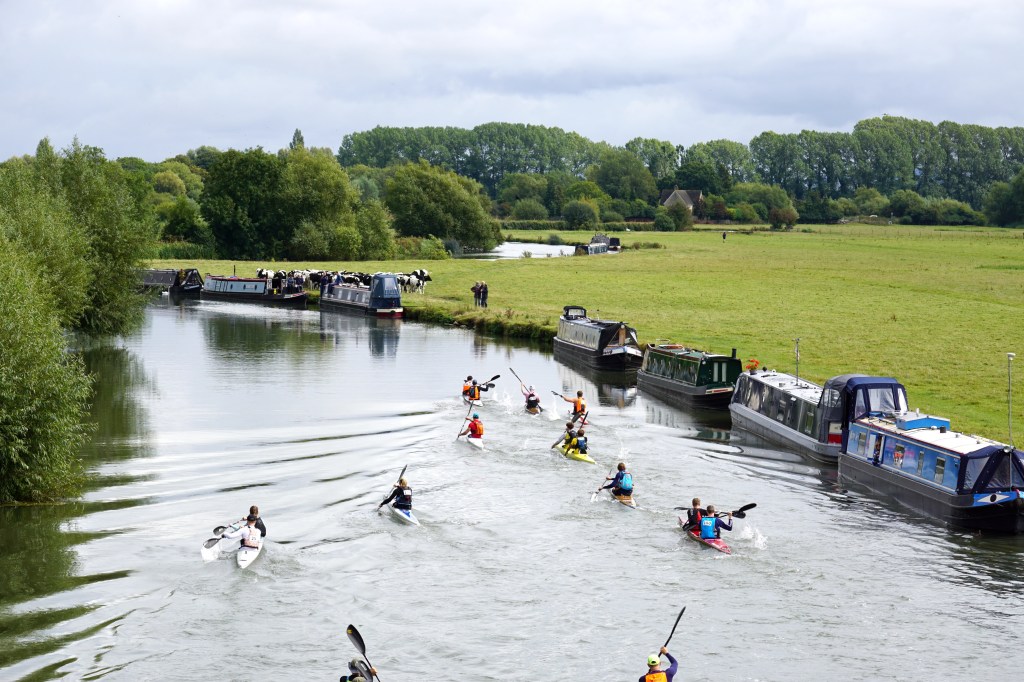
Sprint starts and paddle clashes
After a morning of non-stop pouring rain that drenched the racers from the first start, the heavens finally closed in plenty of time for the 2pm start. The sun shone on a properly festive atmosphere as kayakers and canoeists arrived from around the country. After the 10am start for SUPs, a prone paddler, and slower kayakers, the 2pm start was abuzz with the crews who would be flying down the course in about 15-28 hours. With everyone lining up at the same time for a mass start, we didn’t get the same “will they, won’t they” drama that we saw between some of the top crews at Devizes to Westminster this year. The DW start felt like a game of chicken for who would start first. For the Thames 200 Ultra, there was no tactical early start or late start – it would just be everyone together as fast as you can: a straight up bloodbath.
Several weeks before the race, Paddle Daily predicted which three crews would be in contention for the relay crown: Richmond, Royal, and the Russell Family. Between the first predictions and the race though, minor drama ensued. Jon O’Grady fell ill, and the Royal crew was scrambling for a replacement. The Russell siblings on Team GB limited themselves to just one leg each while their dad doubled up. Chelmsford entered a crew of seven, one more paddler than Richmond or Royal. It was the kind of top end crew that you’d expect from the Race Director’s home club, where the lineup announcement elicited comments like “oh they’ll win for sure”. But Royal made a strong swap at the last minute for Jon O’Grady with Lewis Smith, and stayed in the running. Still, the Chelmsford (“CLM & Cornwall”) crew would be hard to beat, especially with the 7 paddler advantage (versus 4 paddlers for Richmond and 6 for Royal). It was Chelmsford’s race to lose.

Before the race, the top relay crews confirmed on the livestream that they planned to go out strong and solidify their lead. But it was just the first 30 km leg of a 200 km race – how fast would they really go? Turned out – very.
Spectators gathered on either side of the river and peered over the edge of Ha’penny Bridge, the official start of the navigable Thames. Relay teams and straight-through’ers, K1s, K2s, and canoes – thirty odd boats formed a blob across the river. “Thirty seconds” shouted the starter. The relay crews paused for a few seconds, then started pushing the line. “Hold your boats.” They pushed a bit more. The starter raised his voice: “HOLD YOUR BOATS! Back, back, back!” Finally – “Paddlers, GOOOOOO!”
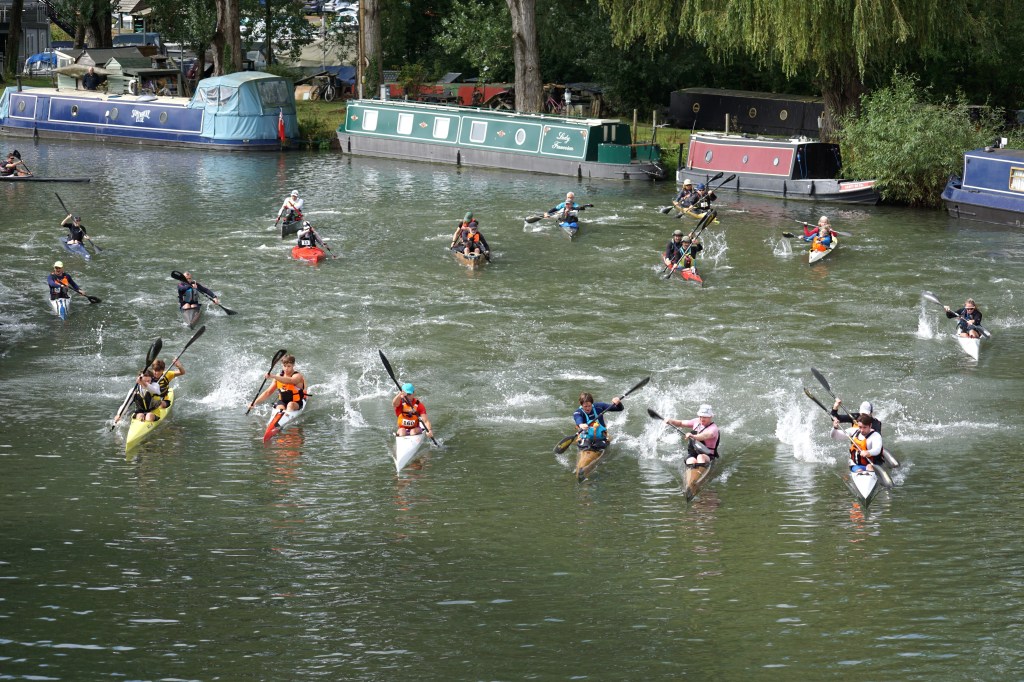
Matt Bowley and Lewis Smith in K2 from Royal started on the outside but rapidly took a leading position alongside Pete Wilkes from the Chelmsford crew. On the inside, the junior crew “Chelmsford Yellows” had a strong start until they got pushed into the side of the bridge. Andy Birkett from Richmond tried to get the early lead he wanted, but suffered a paddle to the face amidst the chaos. Royal’s choice of the outside line may have given them a couple metres longer to get to the bridge, but it guaranteed them clean water – a potentially risky option, but for two sprinters confident in their ability to start fast, it looked like the right choice. Royal and Chelmsford quickly moved into the lead, while Andy managed to keep Richmond in the mix just behind.
Most of the straight-through racers started with slightly less oomph. Although they were all on the same line together, it was easy to see who started in the headspace of “Let’s win the first leg” versus “Pace yourself, we’re going to be out here until tomorrow.” The Rees-Clark siblings started in K2 for the straight-through race, and knew that pacing themselves was going to be one of their biggest challenges. Before the start, Mike Rees-Clark (3rd place DW 2024) said one of their focuses was to keep Sam from “going into race mode.” If she got too focused on speed and race tactics, trying to beat people into portages and sprinting out of them again, they’d burn all their energy way too fast. During their training runs, Mike repeatedly found himself telling Sam to chill out. With her medal-studded experience in marathon kayaking, Sam certainly had the speed, but this was her first ultra: pacing was critical. The Rees-Clarks took off with the fast group. Knowing that they had to hold back, they soon found that the Tonbridge K2 relay teams offered the perfect wash for their pace. They took it, and stuck to their pace.
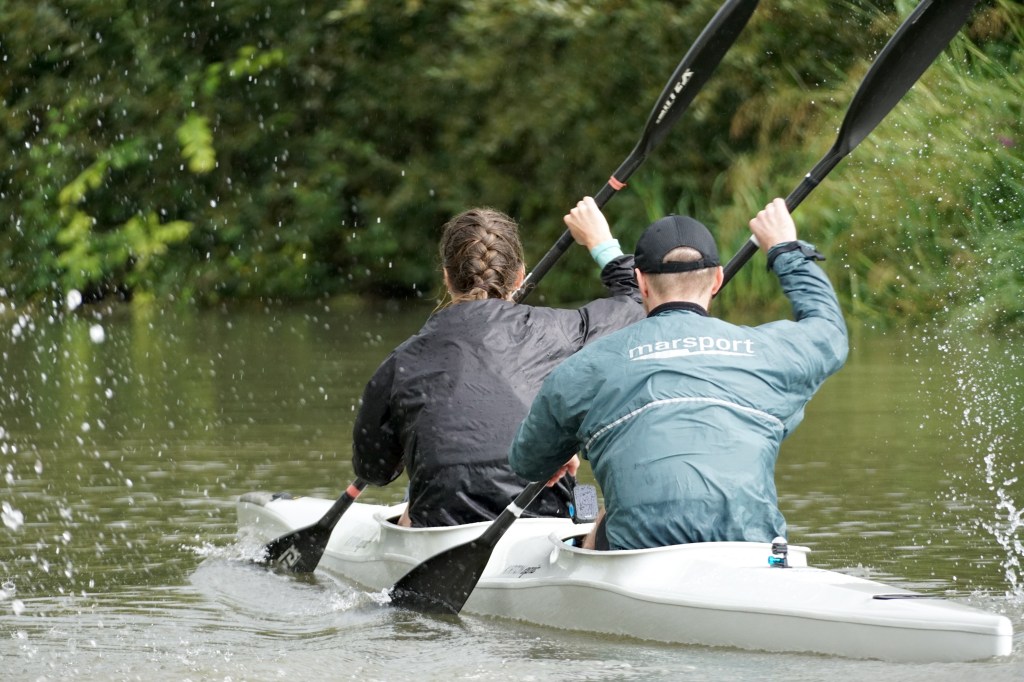
Checkpoint #1: Downpour at Newbridge
Although the racers in the fast start managed to escape the morning’s downpour in Lechlade, the clouds were determined to chase them down. Minutes before the first crews arrived in Newbridge, the heavens opened yet again. Race marshalls, support crews, and Leg #2 relay racers rushed for cover. So much for dry kit and a nice warmup – the paddlers slated to race the next stage were already soaked through.
Matt Bowley and Lewis Smith (K2) from the Royal relay crew came in alongside Pete Wilkes (K1) from the Chelmsford & Cornwall crew. They had absolutely hammered it off the start, and managed to hold their lead the whole way. Andy Birkett, who raced Leg 1 for Richmond, was aiming to take the lead from the first leg but after a paddle to the face and a bit of nerves, he was a couple minutes behind coming into the first checkpoint. There was still a lot of race to go though, and Andy knew he could trust Joe Petersen to make up any lost ground: “If I do get dropped, then he’ll catch up again. He’s pretty strong.” Andy realised later that he was probably a bit nervous on that first leg. He’d make up for it on his second leg through the night though.
| Leaders at Newbridge (Checkpoint #1) CLM & Cornwall (Chelmsford) 1:58:33 Non-Performance Athletes (Royal) +14 seconds RCC & Friends (Richmond) +1 minute 13 seconds |
All three crews passed the first checkpoint within just a couple of minutes of each other, but it wasn’t long until Chelmsford changed that. From Newbridge to Abingdon, Will Stroud (K1) put some real distance between himself and the other two teams: five and half minutes. Behind Will, Joe Petersen was gaining ground for Richmond against Royal. By the time they reached Abingdon, Peterson had more than made up the minute that Richmond were behind at Newbridge – just as Andy predicted.
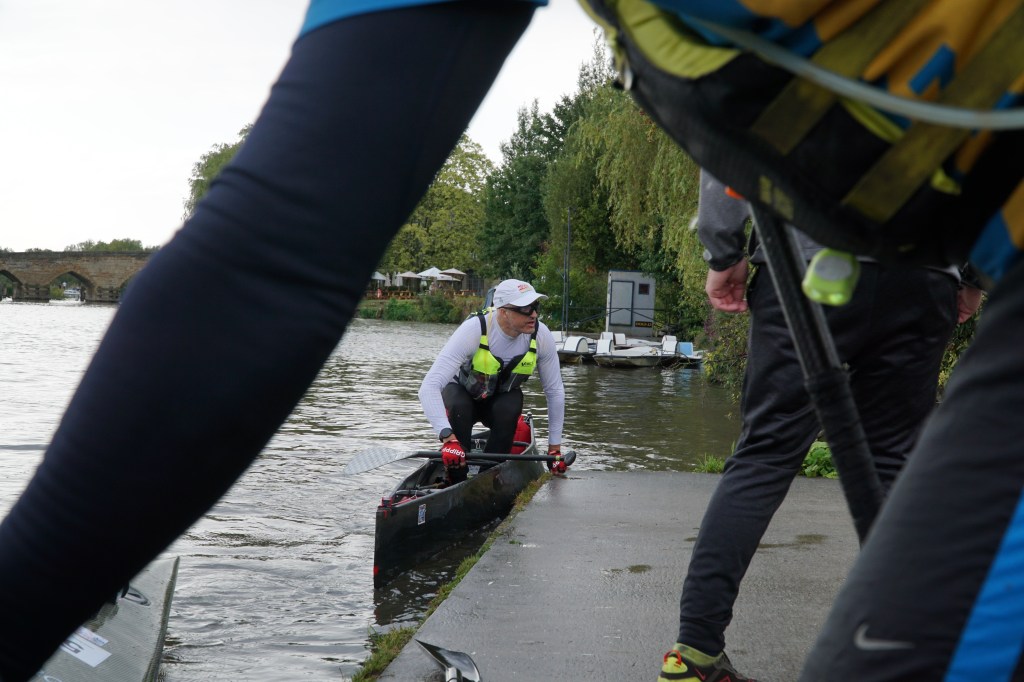
Checkpoint #2: Sunset at Abingdon
Coming out of Abingdon, the Richmond crew was pleased with their progress against Royal, but eager to push ahead of Chelmsford and take the lead. George Durden took Leg 3 for Richmond, a stretch of the river he hadn’t paddled before: “got a bit of a chase down to do with Tim [Gannicott-Porter from Chelmsford & Cornwall]… That’s going to be quite challenging”. Tim, on the other hand, was determined to maintain the lead for Chelmsford.
The sky was still blue in the afternoon light as Will Stroud from Chelmsford raced up to the pontoon near full speed. His teammate grabbed the GPS tracker, slid the necklace up over Will’s head, and slipped it onto Tim within about five seconds: the fastest changeover so far after only one practice earlier at Newbridge. Seconds later, Chelmsford was off again. Unfortunately for Chelmsford though, this would be the last leg where they would lead.
| Leaders at Abingdon (Checkpoint #2) CLM & Cornwall (Chelmsford) 4:51:26 Non-Performance Athletes (Royal) +4 minutes 55 seconds RCC & Friends (Richmond) +5 minutes 48 seconds |
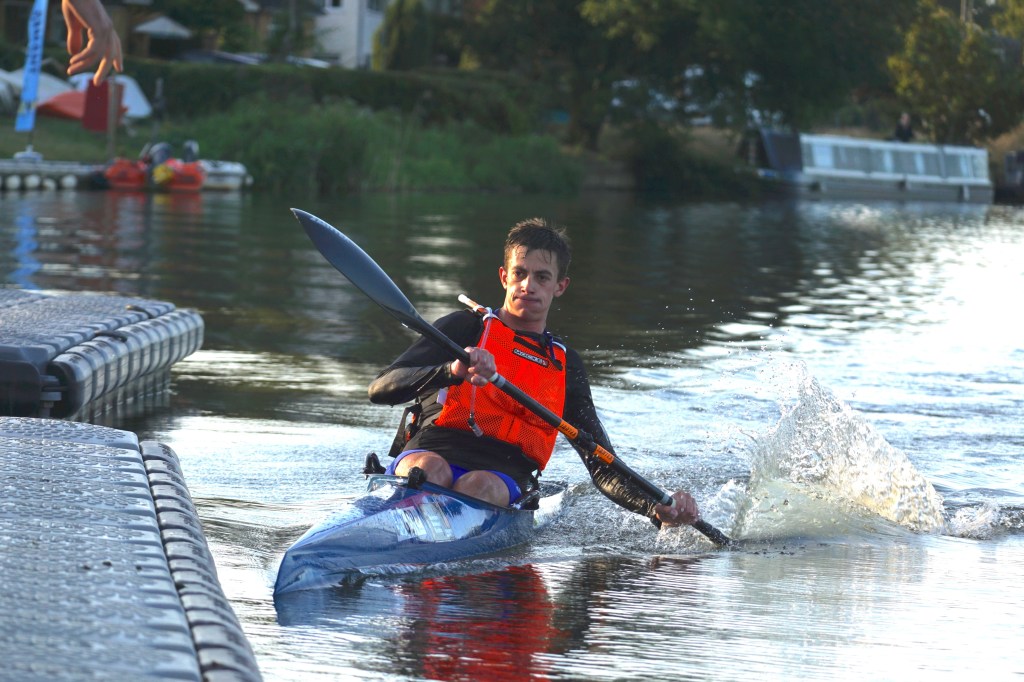
Sunset eked closer, and the minutes stretched long as the Richmond & Royal racers waited for their teammates to arrive behind Chelmsford. Joe Petersen kept his pace up with Royal hot behind him, found his teammates near the downstream end of the pontoon, and George Durden set off after a changeover nearly as fast as Chelmsford’s. Seconds later, Ed Rutherford from Royal walked their K2 to the same spot and waited for Lee Maddocks to grab the GPS tracker from Ben Parfit & Graham O’Regan. Another moment, and the last of the top three teams was off.
Graham and Ben had pushed themselves to the limit for Royal to keep as close as they could to Richmond, and they were feeling it. “Absolutely wrecked. That was a lot further than I thought it would be,” said Graham as he came off the water. Newbridge to Abingdon was one of the two longest legs at 37 km, made a bit worse by copious amounts of weeds. Ben was optimistic though: “We’re still in the game… Feeling confident!” Ben and Graham had only a few hours before they’d be back on the water again for Leg 4, Pangbourne through Reading.
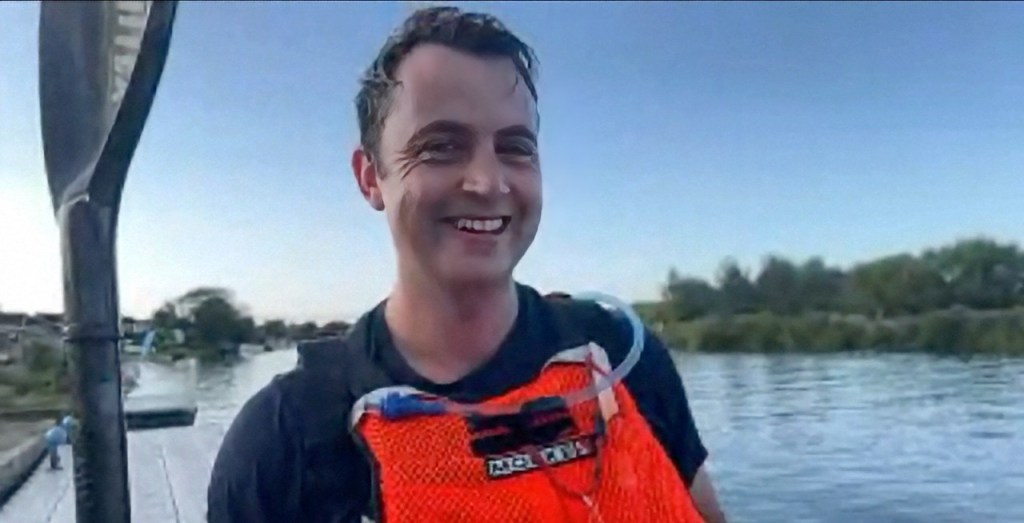
By the time the top three crews reached Pangbourne, it was long past sunset. George Durden pulled off exactly the speedy leg for Richmond that the crew needed, and took them to a lead of just under two mintues. Unfortunately for Chelmsford, this was the leg that started to set them back.
| Leaders at Pangbourne (Checkpoint #3) RCC & Friends (Richmond) 7:47:50 Non-Performance Athletes (Royal) +1 minute 55 seconds CLM & Cornwall (Chelmsford) +1 minutes 59 seconds |
Meanwhile at Abingdon, the next boats passed by as the light started to fade. The junior crew from Chelmsford, Chelmsford Yellows, was just about thirty minutes behind Royal in fourth place for the relay. But the under-18s weren’t allowed to paddle in the dark: the adults stepped in, and Tonbridge caught up with the team. By Pangbourne, they were tied. Then they gained again through the night to Checkpoint 4, but here they got stopped. The team had been so quick that they were hours ahead of sunrise yet. They had to wait before the final under-18 racers could finish off the race. Chelmsford Yellows would go on to have two speedy final legs, but lose that 4th position spot they had before getting held in the dark. Nonetheless, it was an exceptional result for the juniors to be proud of.
Solo straight-through’ers: trouble at the halfway point
The singles race was heating up. Just before sunset, Harry Gilbert pulled into the pontoon at Abingdon for a kit change knowing temperatures would start dropping soon. Harry and Richard (Hendron) Buston had been neck and neck in Newbridge, but Buston had dropped off the pace significantly and Gilbert had a solid lead of more than ten minutes. Knowing he had some catching up to do when he passed Abingdon, Buston didn’t even stop – he checked in verbally and just kept paddling. Later, Richard realised he’d gone off too fast – although he’s a tenured ultra racer with 15 DW finishes, he’d gotten a bit excited off the start and tried to keep up more than was realistic. But it was Harry who would end up not being able to finish.
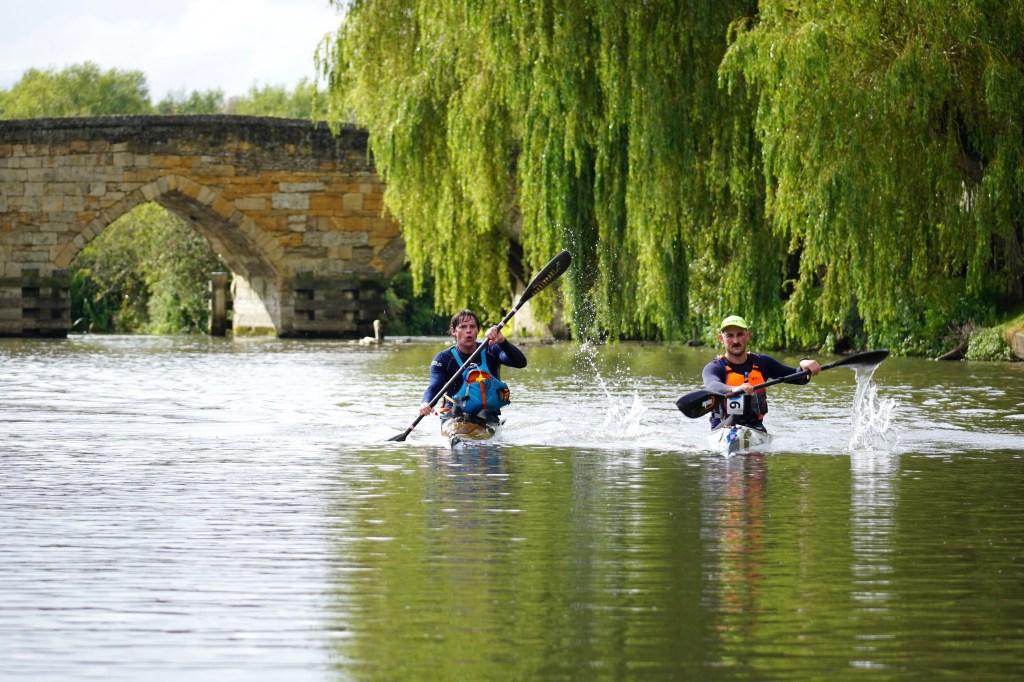
With just about 5 km until the halfway point at Pangbourne, Harry started feeling a bit rough. He pulled into the third checkpoint and suddenly started vomiting. Harry sat down to try and manage the wobbles. Then he started chattering uncontrollably. As his support crew and the race marshalls watched with concern, Harry passed out and went unresponsive. It may have been August, but the nighttime temperature had dropped significantly and a huge effort from Harry over 100 km meant his body was vulnerable to hypothermia. Because he had a medical history with heart issues (Supraventricular tachycardia “SVT” where your heart suddenly beats much faster than normal), the ambulance crew decided to take Harry to the hospital for observation.
Harry recovered quickly. In his words: a faster recovery from the incident than from paddling 100 km. He expressed gratitude to the race marshalls at Checkpoint 3 with a special thanks to Mr. Rees-Clark “for recovering my favourite hat.” After Harry’s withdrawal, it was Richard’s race to lose. He stuck to a more tempered pace through the night, drew on his extensive DW experience to navigate, and arrived smoothly at the finish as the first straight-through solo paddler.
Through the night: the moon and the mist
Not long after sunset, the moon glowed orange briefly as it rose above the horizon. Racers were treated to its cool light along the twists and turns of the river – much needed in the upper section of the Thames where streetlights are miles away. After a few hours though, the moon set and the mist crept in. Navigating in the dark is a challenge on its own, but in the mist, paddlers could only see a couple metres in front of them.
Racing through the centre of Reading, they were greeted by lights, cheers and confusion from Reading Festival goers. When the canoe relay crew (the “Barbarians”) raced paddled Reading a few hours behind the lead kayaks, they got some wolf whistles and questions from the festival goers but made it through smoothly. Brett Irvine, who was racing K1 for Richmond in this leg, said he actually enjoyed going through the middle of the festival: “Going through Reading was quite nice… we had all this music.”
The top three relay crews stayed close from Pangbourne through Reading, until Richmond pulled away and Royal ran into navigation woes. Brett Irvine had been saving energy all day – he even took an afternoon nap – and was ready to give it 100% for 35 km in his only leg. By the time they’d passed Reading, Richmond had shot out ahead. Chelmsford’s K2 of Dan Palmer and Martyn Collinge were just behind Royal until Sonning lock. The Royal K2 of Graham and Ben were in their second leg of the race and seemed to have gone around the wrong side of the island. Luckily for Martyn and the Chelmsford team, Dan Palmer has eight DW finishes and knows that section like the back of his hand. He and Martyn overtook the Royal K2 until Graham and Ben came steaming up behind them after sorting out their navigation. The two K2s stayed close until the next checkpoint: Water Safety, between Hurley and Marlow. Richmond was leading, but it was still anyone’s race.
| Leaders at Water Safety (Checkpoint #4) RCC & Friends (Richmond) 10:43:23 Non-Performance Athletes (Royal) +6 minutes 22 seconds CLM & Cornwall (Chelmsford) +7 minutes 26 seconds |
Andy Birkett got back on the course for Richmond, ready to redeem his third place finish in the first leg. It was exactly the performance he wanted. Andy built up even more of a lead for Richmond: by the time he got to Staines, Richmond was ten minutes up. Behind Andy, it was Chelmford’s turn for navigation woes. James Walkington and Declan Strong arrived in K2 to the notoriously confusing Cookham Lock. They had been moving well, but couldn’t figure out which was the right channel. James and Declan decided to phone a friend. “I got a phone call at three o’clock in the morning saying ‘which way is it.’” Their teammate Tim Gannicott-Porter sorted them out, but they’d lost too much time. By the time they reached Staines, Chelmsford was more than thirty minutes behind Royal and over forty minutes behind Richmond. Will Stroud and Pete Wilkes are an incredibly fast K2, but even with all their speed, it was too much to recover in the final leg.

| Leaders at Staines (Checkpoint #5) RCC & Friends (Richmond) 13:41:31 Non-Performance Athletes (Royal) +10 minutes 15 seconds CLM & Cornwall (Chelmsford) +43 minutes 23 seconds |
The podium finish
Joe Petersen jumped in for Richmond to take it home. He just had to keep up the lead at this point – they had ten minutes of buffer. The Richmond team knew they’d need the buffer, and they were happy to have it because Matt Bowley and Lewis Smith had plenty of time to rest since their sprint start on Saturday afternoon and were ready for a sprint finish. Ten minutes behind, Matt and Lewis raced after Joe. But Richmond’s buffer held. Joe Petersen finished the final leg in 02:12:12, slower than Matt and Lewis’ 02:07:36 but in more than enough time to take first place.
Heading toward home water at Richmond, Joe passed his teammates crowded around giant pink “RACE FINISH” banners aiming for Teddington Lock. Racers had to go all the way to the lock to reach the official end of the navigable non-tidal Thames before turning around and finishing 200 km at the YMCA Hawker. Matt and Lewis weren’t far behind. Their Royal teammates at the finish crossed their fingers – maybe Joe would fall in. And forget how to swim? Anything to keep him busy for seven minutes…
At 5:53am, Joe crossed the finish. Race Director Keith Moule walked over with medals and champagne. Andy popped the bottle, shook it up some more, and sprayed Joe in celebration. It wasn’t even sunrise yet.

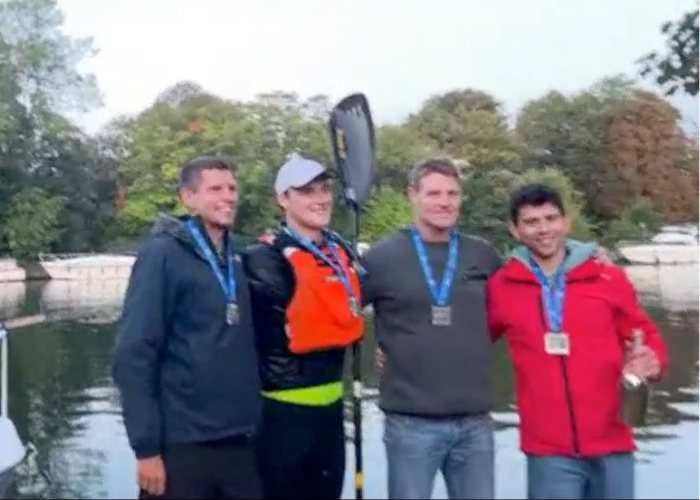
Matt and Lewis arrived a few minutes later, tired and happy, if a bit disappointed that they hadn’t quite managed to catch Joe. Both teams finished in under 16 hours: 15:53:43 for Richmond, and 15:59:22 for Royal. At 6:03am, the sun finally rose. Pete and Will were absolutely hammering it down the course reminding everyone just how good of a K2 they make. The CLM & Cornwall crew finished the last leg in just 01:57:24, easily the fastest time of the day. But their overnight deficit from the previous team losing their bearings at Cookham was too much to overcome. The Chelmsford relay team finished in 16:22:18.
| Relay Podium (Finish at Teddington) RCC & Friends (Richmond) 15:53:43 Non-Performance Athletes (Royal) +5 minutes 39 seconds CLM & Cornwall (Chelmsford) +28 minutes 35 seconds |
A few more finishes
Tonbridge Canoe Club’s relay team arrived next in 18:26:30, just a few minutes before the Rees-Clark siblings who raced all 200 km straight-through: the fastest straight-through finishers in 18:34:13. They hung with the Tonbridge team for most of the race once they realised how well-matched they were in speed. Not only did the Rees-Clark siblings finish fifth-fastest overall and faster than most (seven) relay crews, they also finished in absolutely perfect form. Every time the Paddle Daily crew spotted the Rees-Clark siblings on the water, they were in perfect time. They looked exactly how they did at the start. Almost every other straight-through crew (and many relay crews) arrived at the finish with the sort of form that says ‘I’ve just paddled 200 km, all I care about is getting to the finish line and minimising the pain where I can.’ That may well be how the Rees-Clarks felt, but watching from the riverbank, it looked perfect.
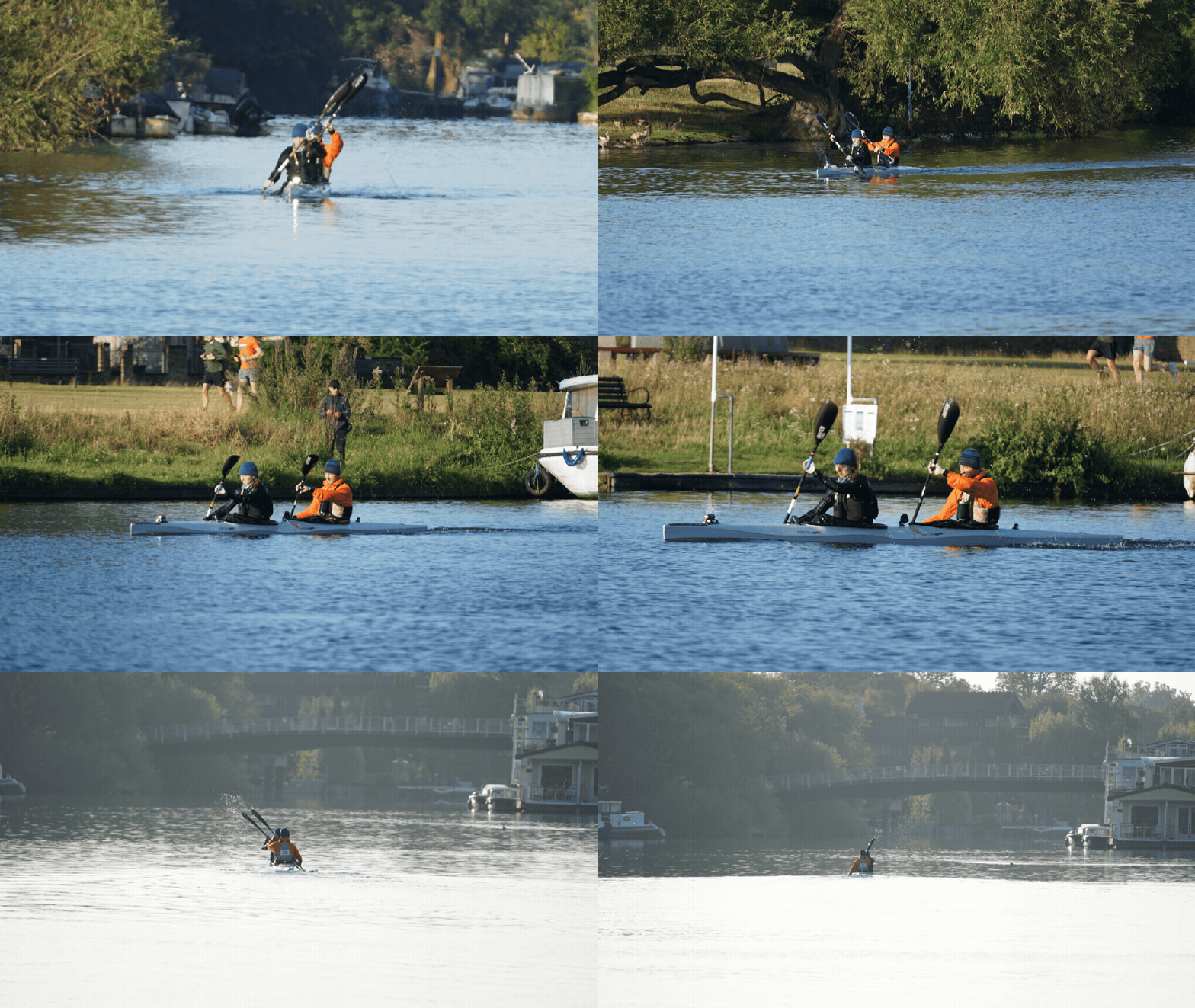
The next four finishers were relay crews: Sweet Thamestation (Oxford Falcon), The Russell Family, Exeter Canoe Club, and Chelmsford Yellows. The junior crew of the Chelmsford Yellows may have finished ninth, but had they not been held at Checkpoint 4 before sunrise, they would have had the fourth fastest time overall. Their final crew finished the last leg in 02:06:57, which, according to the GeoTracks GPS, would mean they had the second fastest final leg overall, behind only the third place Chelmsford crew. Given the time lag while the juniors waited for sunrise, they did potentially have more of a push from a mid-morning tailwind, but it’s exceptional results for a junior team who may have to put adults in their fourth leg next year to avoid a wait.
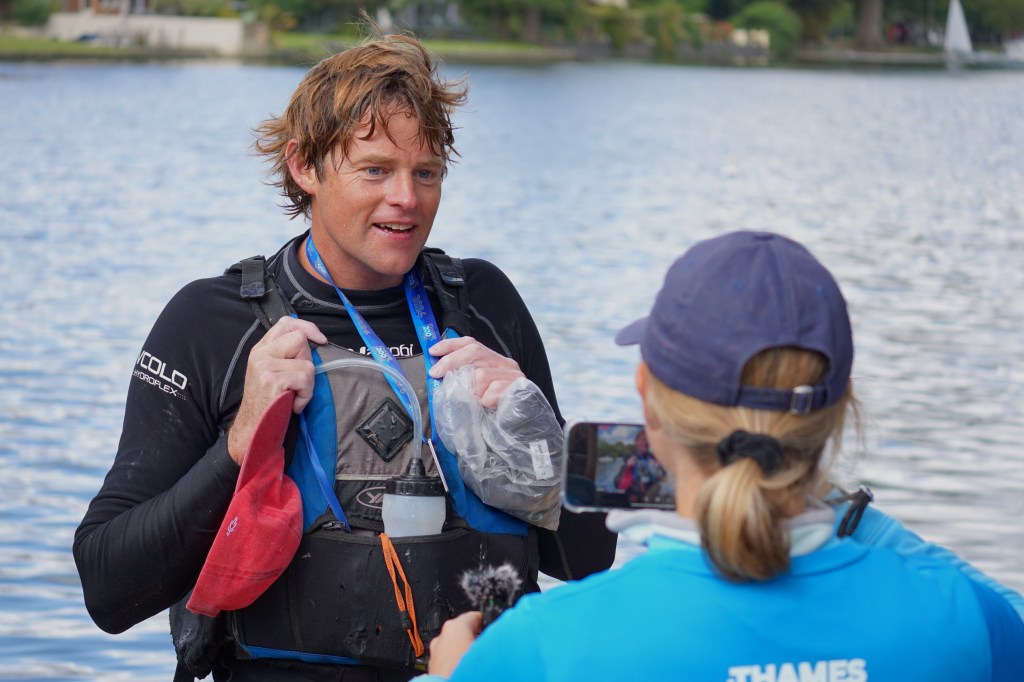
The remaining boats trickled in. Richard Buston was the fastest solo straight-through paddler, followed by Thor Harley in C1. Both set new fastest known times for K1 and C1 length of the Thames. Gavin Symonds was the first SUP to finish, completing the race in under thirty hours which some had called “impossible” just weeks prior. He and Chris Davison finished in 29:19:50 and 29:35:48 respectively, setting the new standard for SUPing the length of the Thames. You can find a recap of the SUP race over at supracer.com.
The records we can now obsess over
The length of the Thames has a few Guinness World Records associated with it, including the record that Billy Butler broke earlier this year with Tom Dawson: 15 hours 44 minutes. But the Guinness records are cumbersome – only some records are ‘official’ (for example, there don’t seem to be official records for ‘fastest female’ available), record-setters have to submit a huge body of video evidence including GPS and witnesses, and it’s expensive to apply.
It’s time for a new record tracker. Check it out at paddledaily.com, and subscribe to the website, YouTube, and social media to follow along as more records fall in the coming months.
 Paddle Daily
Leave a comment